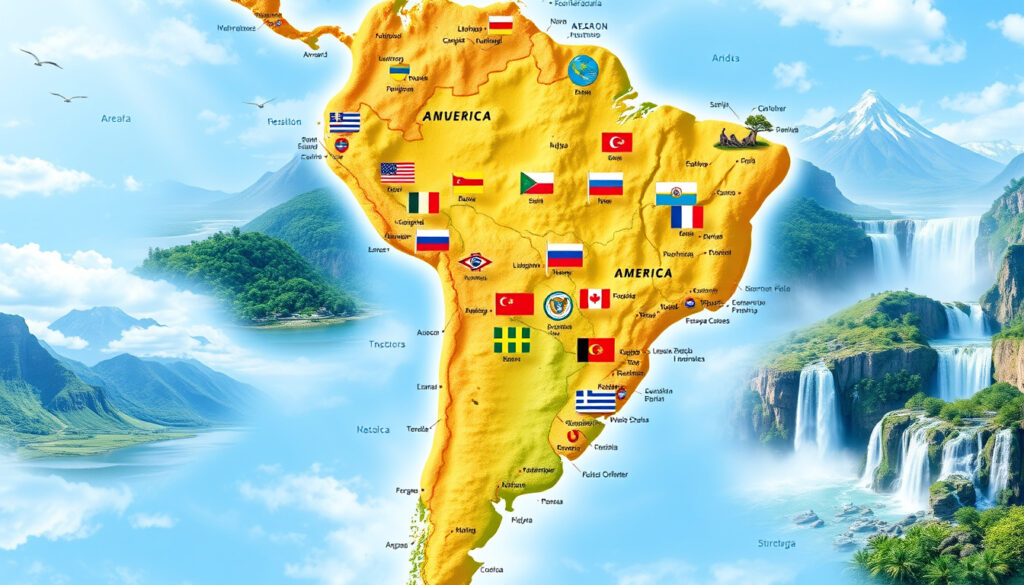
Countries in South America: List of 12 Nations + Key Facts
The internet insists South America has 17 or even 23 countries — it doesn’t. The continent has exactly 12 sovereign nations, and confusing them with dependencies or other regions fuels persistent myths. Here is a data-backed breakdown of every country, plus 2025 safety rankings, GDP per capita figures, and poverty metrics so you can compare them on what actually matters for travelers, investors, and curious readers.
Sovereign Countries: 12 · Including Dependencies: 14 · Largest by Area: Brazil · Most Populous: Brazil · Land Area: 17.84 million km²
Quick snapshot
- 12 sovereign nations span the continent (World Population Review)
- Brazil holds 49% of South America’s total land area (World Population Review)
- Combined population exceeds 420 million people (World Population Review)
- French Guiana’s sovereignty status (French overseas department)
- Falkland Islands political standing (claimed by Argentina, administered by UK)
- Ecuador declared nationwide internal armed conflict in January 2024 (Grow Dangerously)
- 2025 Global Peace Index shows regional average GPI of 2.180 (Grow Dangerously)
- Guyana’s oil boom is reshaping its economic position ($30,888 GDP per capita in 2025) (World Population Review)
- Regional safety gap between Southern Cone and Andean nations continues to widen (World Population Review)
Three tables anchor the comparisons below: GPI scores for safety, IMF figures for wealth, and World Bank data for poverty. Each draws from published sources so you can verify the numbers yourself.
| Metric | Value |
|---|---|
| Sovereign States | 12 |
| Dependencies Included | 14 |
| Population | 420+ million |
| Continent Rank by Size | 4th |
How Many Countries in South America?
The answer is 12 sovereign countries. Argentina, Bolivia, Brazil, Chile, Colombia, Ecuador, Guyana, Paraguay, Peru, Suriname, Uruguay, and Venezuela make up the full list. No AI hallucination or outdated quiz will change that — the United Nations recognizes all 12 as member states.
Common misconceptions like 17 or 23 countries
Where do the inflated counts come from? Some people add French Guiana, which is a French overseas department, not an independent nation. Others mistakenly include Caribbean island nations or Central American states. The number 23 likely stems from confusing South America with Latin America as a whole — a region that encompasses 20+ sovereign nations across two continents.
French Guiana houses France’s Guiana Space Centre, making it strategically significant, but its residents hold French citizenship and the territory remains under European Union jurisdiction.
Sovereign states vs dependencies
The distinction matters for international business, visa requirements, and political analysis. Sovereign states have their own governments, currencies, and representation at the UN. Dependencies operate under another nation’s administration — French Guiana under France, for instance.
The implication: when you’re researching immigration policy, tax structures, or travel advisories, always check whether your target territory has self-governance or operates under an external power’s legal framework.
What are the Top 5 Biggest Countries in South America?
Brazil dominates the continent by a wide margin. It spans 8.5 million km² — roughly equal to the combined area of the next four largest countries. Understanding size rankings matters for logistics, resource extraction, and regional political dynamics.
By land area ranking
Here is how the continent’s land area breaks down:
| Rank | Country | Approximate Area (km²) |
|---|---|---|
| 1 | Brazil | 8,516,000 |
| 2 | Argentina | 2,780,400 |
| 3 | Peru | 1,285,216 |
| 4 | Colombia | 1,141,748 |
| 5 | Bolivia | 1,098,581 |
Brazil dominance
Brazil alone accounts for roughly 49% of South America’s total landmass. Its territorial reach stretches from the Atlantic coast to the Andes foothills, encompassing the Amazon Basin — the world’s largest tropical rainforest. This geographical span gives Brazil unmatched biodiversity, hydroelectric potential, and agricultural capacity. The country’s sheer scale means regional trade agreements, infrastructure projects, and environmental policies cannot proceed without Brazilian involvement.
Brazil’s agricultural output — soy, beef, coffee — shapes global commodity prices. Any supply chain analysis for South America must start with Brazilian production figures and logistics infrastructure.
What’s the Safest South American Country?
The 2025 Global Peace Index provides the most comprehensive safety ranking for the continent. The index scores countries based on ongoing conflict, safety in society, and militarization. Lower scores indicate safer conditions.
Safety metrics
Argentina leads South America with a GPI score of 1.768, followed closely by Uruguay at 1.784. Chile ranks third at 1.899. These three countries form what analysts call the Southern Cone cluster — a region with low violent crime rates, stable political institutions, and effective law enforcement.
| Country | 2025 GPI Score | Global Rank | US Advisory Level |
|---|---|---|---|
| Argentina | 1.768 | 46 | Level 1 — Exercise Normal Precautions |
| Uruguay | 1.784 | 48 | Level 2 — Exercise Increased Precautions |
| Chile | 1.899 | 62 | Level 2 — Exercise Increased Precautions |
| Paraguay | 1.981 | 75 | Level 1 — Exercise Normal Precautions |
| Bolivia | 2.005 | 83 | Level 2 — Exercise Increased Precautions |
Traveler recommendations
Uruguay stands out for travelers seeking low crime and political stability. According to Going (travel guide publisher), the country ranks high for personal safety and has maintained democratic governance without interruption for decades. Chile attracts visitors with modern infrastructure — roads, hospitals, and telecommunications systems that rival European standards, according to Grow Dangerously (independent newsletter). Argentina’s US State Department advisory remained at Level 1 as of mid-2025, signaling that the government considers routine precautions sufficient for most travelers.
Ecuador’s security situation deteriorated sharply. The country declared a nationwide internal armed conflict in January 2024, and its GPI ranking worsened to 129th globally by 2025. Travelers should reconsider non-essential trips and consult current advisory updates before visiting.
What this means: safety in South America isn’t uniform. The Southern Cone offers comparable security to Southern Europe, while Andean and Amazonian nations face structural challenges that affect daily life and tourism infrastructure.
Which Country is Most Friendly to Americans?
Friendliness toward American visitors varies by region and context. Cultural affinity, historical ties, and economic interdependence shape how residents perceive tourists from the United States.
Tourist perceptions
Colombia has made deliberate efforts to rebrand itself as a welcoming destination for international tourists following decades of internal conflict. The government’s “Colombia es Pasión” campaign targeted American and European visitors specifically, and US visitor numbers have increased substantially since 2015. Travelers frequently report warm receptions in Medellín, Bogotá’s historic La Candelaria district, and the Caribbean coast.
Uruguay offers a different kind of hospitality — quieter, more reserved, but consistently respectful toward visitors. The country’s small population and European-influenced culture mean interactions tend toward formality, but crime targeting tourists remains rare.
Cultural attitudes
Argentine society has strong cultural connections to Western Europe, and American visitors generally find familiar social cues in Buenos Aires — coffee culture, bookstore scenes, and a thriving arts community. However, economic turbulence and political polarization occasionally surface as conversational topics with locals.
The implication: “friendliest” depends on what you’re seeking. Colombia wins for overt hospitality and nightlife-driven tourism. Uruguay excels for peaceful, low-key exploration where you blend in rather than stand out.
What is the Poorest Country in South America?
Venezuela holds the distinction of being South America’s poorest nation by GDP per capita. The 2025 IMF estimates place Venezuelan GDP per capita at just $3,805 — far below regional neighbors. However, poverty metrics reveal a more complicated picture across the continent.
GDP per capita metrics
Economic wealth isn’t distributed evenly. Guyana’s oil discoveries have transformed its financial position — the country now boasts the continent’s highest GDP per capita at $30,888 in 2025, according to IMF data. The stark contrast with Venezuela ($3,805) represents a 14-fold difference in average income.
| Country | 2025 GDP per Capita (IMF) |
|---|---|
| Guyana | $30,888 |
| Uruguay | $15,000+ (estimated) |
| Chile | $15,000+ (estimated) |
| Brazil | $9,990 |
| Colombia | $6,000+ (estimated) |
| Suriname | $7,042 |
| Bolivia | $4,478 |
| Venezuela | $3,805 |
Economic challenges
Bolivia ranks second poorest with a GDP per capita of $4,478. Despite lower poverty ratios at the $5.50/day threshold (15.2% in 2021), the country faces structural constraints: landlocked geography, limited diversification beyond natural gas and mining, and uneven infrastructure development outside major cities.
Venezuela’s situation stems from a combination of political instability, sanctions, and economic mismanagement. Hyperinflation has eroded savings, infrastructure has deteriorated, and migration has reduced the available workforce. The World Bank’s poverty data reflects these pressures even as international aid organizations attempt to provide basic services.
Colombia shows the highest poverty ratio at $5.50/day — 38.8% in 2021, according to The Global Economy (World Bank data aggregator). Peru follows closely at 33.4%. These figures suggest that middle-income countries can still have substantial populations living in deprivation.
What this means: GDP per capita masks distribution issues. A country can have a higher average income while still containing larger swaths of poverty than a neighbor with a lower average. Investors and aid organizations need both metrics to assess genuine living standards.
Upsides
- Southern Cone nations (Argentina, Uruguay, Chile) rank among the safest globally
- Guyana’s oil economy is rapidly elevating living standards
- Uruguay’s poverty rate (6.7%) is among the continent’s lowest
- Multiple countries offer modern infrastructure and stable governance
Downsides
- Ecuador’s security collapse requires reassessment of travel plans
- Venezuela’s GDP per capita ($3,805) reflects severe economic distress
- Colombia’s poverty ratio (38.8%) affects over a third of the population
- Wide gaps between richest and poorest nations create regional instability
“Argentina ranks as the safest country in the list, with a Global Peace Index score of 1.768.”
— Benoit Properties (real estate and investment analysis)
“Chile boasts modern infrastructure, low violent crime rates.”
— Grow Dangerously (independent travel analysis)
“Uruguay is widely considered one of the safest South American countries, ranking high for political stability, low crime rates.”
— Going (travel guide publisher)
Related reading: Map of New Zealand: Detailed, Tourist & Printable Guides · How to Apply for NZ Citizenship: Requirements, Costs & Process
worldoftravelswithkids.com, going.com, theglobaleconomy.com, worldpopulationreview.com, exoticca.com, en.wikipedia.org, youtube.com, visionofhumanity.org
While our key facts highlight the biggest and safest spots, a detailed list and facts offers deeper insights into all 12 sovereign nations across the continent.
Frequently asked questions
Is Guyana in South America?
Yes. Guyana is a sovereign member of the UN and shares borders with Brazil, Venezuela, and Suriname. It became independent from the United Kingdom in 1966 and operates as a representative democracy.
Is Brazil the largest country in South America?
Yes. Brazil spans approximately 8.5 million km² — larger than the next four countries combined and accounting for roughly 49% of the continent’s total area.
What separates South America from North America?
The Darién Gap — a stretch of impenetrable rainforest spanning about 100 km between Panama and Colombia — marks the traditional boundary. Geopolitically, the division aligns with the Panama-Colombia border and reflects distinct colonial histories.
Are there 12 or 14 countries in South America?
There are 12 sovereign countries. Including dependencies (French Guiana, the Falkland Islands), the count reaches 14. However, no authoritative source lists 17, 23, or 54 countries in South America — those figures result from confusion with Latin America or incorrect inclusions.
Which South American country has the highest population?
Brazil, with approximately 215 million residents as of recent estimates. It holds roughly half of South America’s total population of 420+ million people.
Is Mexico part of South America?
No. Mexico is in North America, geographically and politically. It participates in different regional organizations (USMCA, OAS) and shares cultural ties with Central America rather than the Andean or Southern Cone regions.
What is the smallest country in South America?
Suriname, spanning approximately 163,821 km². It is also the smallest independent country on the continent; French Guiana (as a French department) is smaller but not sovereign.
More related posts
 Dry Herb Vaporizer NZ: Legality, Health & Buying Guide
 Chiefs (Super Rugby) – Location, Titles, Ownership & FAQ
 Mortgage Rates Comparison NZ: Latest and Best Deals
 Pet Insurance for Dogs in Ireland: Costs & Waiting Periods
 How Did Ed Gein Die? Cause of Death and Verified Facts
 1 NZD to Thai Baht – Live Rate, Forecast & Conversions
 Westpac Mastercard Travel Insurance – What You Need to Know
 How to Withdraw KiwiSaver: Eligibility, Steps & Rules