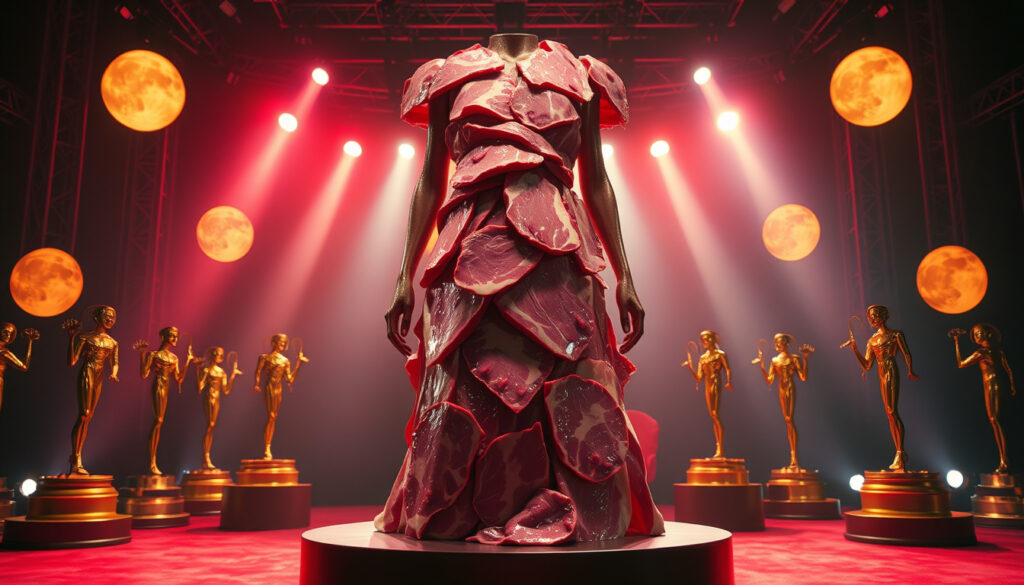
Lady Gaga Meat Dress: Meaning, Story at 2010 VMAs
Lady Gaga arrived at the 2010 MTV Video Music Awards in a dress made entirely from raw beef, sparking immediate controversy and cementing herself as fashion’s most provocative performance artist. Fifteen years later, the dress remains preserved as a museum artifact—a wearable political statement that weaponized flesh, mortality, and celebrity visibility into a single, unforgettable image.
Event Date: September 6, 2010 · Location: MTV Video Music Awards · Designer: Franc Fernandez · Material: Raw flank steak · Stylist: Nicola Formichetti
Quick snapshot
- Made from raw flank steak (TIME Newsfeed)
- Designed by Argentinian designer Franc Fernandez (TIME Newsfeed)
- Worn while accepting Video of the Year award (PETA Official)
- Exact production cost of the dress
- Current precise museum location
- 2010 VMAs → Tanned and preserved → Rock and Roll Hall of Fame (2011) (Pop History via YouTube)
- The dress remains on display as a cultural artifact; September 2025 marks its 15th anniversary
Six key data points anchor the story of this iconic—if divisive—fashion statement:
| Detail | Value |
|---|---|
| Worn At | 2010 MTV VMAs |
| Date | September 6, 2010 |
| Meat Type | Flank steak |
| Weight | Real raw beef |
| VMA Nominations | 13 (record at the time) |
| Awards Won | 8 moon man awards |
What did Lady Gaga’s meat dress mean?
Lady Gaga was 24 years old and at the height of her Fame Monster era when she arrived at the September 2010 MTV Video Music Awards wearing a dress constructed entirely from raw beef. She had already made waves earlier that month posing in a meat bikini for Vogue Japan’s September issue, which preceded the VMAs. The 2010 VMAs marked a historic moment for Gaga: she received 13 nominations, breaking the record at the time, and took home 8 moon man awards.
Symbolism explained
Gaga explained the dress as a protest against the U.S. military’s “Don’t Ask, Don’t Tell” policy, which prohibited openly gay individuals from serving in the armed forces. While accepting the Video of the Year award for “Bad Romance,” she wore the raw meat dress to make a statement that was impossible to ignore.
“If we don’t stand up for what we believe in. If we don’t fight for our rights, pretty soon we’re going to have as much rights as the meat on our bones.”
— Lady Gaga, 2010 MTV VMAs acceptance speech
The message drew a direct parallel between the treatment of animals and the dehumanization of LGBTQ+ individuals under the discriminatory policy. Weeks after the VMAs, she spoke at a rally in Portland, Maine, urging state senators to vote to repeal Don’t Ask, Don’t Tell. At that rally, she directly referenced the meat dress, questioning: “Shouldn’t everyone deserve the right to wear the same meat dress as I do?”
Designer intent
Makeup artist Val Garland inspired the concept by telling Gaga she had worn a version of a meat dress in the 1980s. Garland created her own version by flattening steaks into a bra bikini top and cooking bacon into boots for a day party in the club culture scene.
Gaga transformed a club-culture concept into mainstream protest fashion. The timing—during peak visibility at the VMAs—amplified her message far beyond what a traditional speech could achieve.
Is the Lady Gaga meat dress made out of real meat?
Yes, the dress was made from real, raw flank steak—the kind you’d find at a butcher’s counter. This was not a prop or a clever illusion. The choice of actual meat rather than synthetic alternatives was deliberate, both for shock value and for the sensory authenticity that supported her larger message about flesh, mortality, and rights.
Material details
Franc Fernandez, an Argentinian designer working with House of Gaga, designed the meat dress. He had previously designed costumes for Gaga’s “Bad Romance” music video, making him a trusted collaborator for high-concept fashion moments.
The dress featured a cowl neck, matching beefy boots, a hat, and a meat clutch—all constructed from prime cuts of raw meat. According to Gaga herself, the dress actually smelled like meat, creating a visceral experience for everyone in proximity.
Construction process
The technical challenges of constructing a wearable meat dress were significant. The dress was cut backstage in coolers and Gaga was sewn into it for the first time at the VMAs. A corset under the dress anchored the entire garment together, providing structure and support for the delicate raw material.
The construction required precise choreography between designer, stylist Nicola Formichetti, and Gaga herself. Without the corset system, the dress would have collapsed under its own weight—raw meat lacks the structural integrity of fabric.
The pattern: a collaboration between fashion innovator (Fernandez), styling vision (Formichetti), and performance art (Gaga) produced a garment that was simultaneously costume, protest, and wearable sculpture.
How did Lady Gaga’s meat dress stay together?
Given that raw meat is not exactly a sturdy textile, the structural engineering behind the dress was critical. The answer lay in both internal support systems and post-event preservation efforts that transformed perishable beef into a museum-worthy artifact.
Assembly method
The dress relied on two key structural elements: strategic cutting and an underlying corset. The meat pieces were stitched and glued together backstage in refrigerated conditions to maintain freshness as long as possible. Once Gaga was sewn into the dress, the corset provided the load-bearing framework that kept the meat panels suspended and wearable.
Preservation techniques
After the VMAs, the dress could not simply be hung in a closet. Preservation required professional intervention: the dress was placed in a meat locker, bathed in chemicals, and dried out by taxidermists in California before being transported to its display location. This tanning process arrested the decomposition that PETA founder Ingrid Newkirk had warned about, ensuring the garment could survive as a permanent artifact rather than becoming a biohazard.
PETA’s criticism proved prophetic in the short term—the dress did require immediate preservation efforts. However, taxidermy techniques successfully transformed a perishable fashion moment into a lasting cultural artifact.
The catch: what looked like a throwaway stunt became a permanent museum piece precisely because the underlying construction and preservation were taken seriously, despite the deliberately provocative presentation.
What was Lady Gaga’s meat dress protesting?
The meat dress was a deliberate, theatrical protest against the “Don’t Ask, Don’t Tell” policy (DADT), the U.S. military’s ban on openly gay service members that had been in effect since 1994. Gaga was an outspoken advocate for LGBTQ+ rights, and the VMAs platform—where she was the most-nominated artist—gave her an audience of millions.
Political message
The visual metaphor was deliberately stark: meat as flesh, flesh as identity, and the question of who has the right to exist without being consumed or discarded by the system. By wearing the dress while accepting the Video of the Year award, Gaga ensured her protest would dominate post-show coverage rather than disappearing into entertainment news.
The policy she protested—Don’t Ask, Don’t Tell—was repealed on September 20, 2011, approximately one year after the meat dress incident. While correlation does not prove causation, Gaga’s activism at the Portland rally and her use of the dress as a symbol contributed to the cultural climate that preceded the repeal.
Cultural impact
The meat dress transcended fashion and politics to become a cultural touchstone. It is considered one of the most memorable fashion moments from the entire 2010s decade, frequently referenced in discussions of provocative fashion, celebrity activism, and the intersection of art and protest.
“Meat is something you want to avoid putting on or in your body, no matter how beautifully it is presented, flesh from a tortured animal is flesh from a tortured animal.”
— PETA statement on Vogue Japan meat bikini shoot
Gaga posed in a meat bikini for Vogue Japan earlier in September 2010, establishing the visual motif before the VMAs. This foreshadowing meant audiences were primed to recognize her continued use of the meat aesthetic as a deliberate statement rather than a one-off shock tactic.
How did PETA react to the meat dress?
PETA’s response was swift and harsh. The organization published an official statement the day after the VMAs aired, with founder Ingrid Newkirk delivering particularly pointed criticism. The animal rights group also commented on the Vogue Japan meat bikini shoot, creating a secondary front in their critique.
Official statements
PETA founder Ingrid Newkirk did not hold back in her assessment. She stated that meat is “the decomposing flesh of an abused animal who didn’t want to die, and after being under the TV lights it would smell like the rotting flesh that it is and likely be crawling with maggots.” The vivid language matched the visual shock of the dress itself.
“If we don’t stand up for what we believe in. If we don’t fight for our rights, pretty soon we’re going to have as much rights as the meat on our bones.”
— Lady Gaga, 2010 MTV VMAs acceptance speech
The organization accused Gaga of simply trying to keep herself in the spotlight by displaying butchery as fashion. This criticism framed the dress as narcissistic spectacle rather than genuine protest.
Broader criticism
Gaga responded to the criticism by clarifying that the dress was not meant to disrespect vegans or vegetarians. She emphasized that the statement was about human rights, not animal treatment, and that she supported people’s choice to follow plant-based diets.
Ellen DeGeneres, interviewing Gaga about the dress, presented her with a veggie bikini and skirt as an alternative—suggesting that activism and vegetarianism could coexist. This exchange highlighted the tension between different forms of advocacy.
Gaga’s human-rights message generated more cultural impact than a vegetarian advocacy statement likely would have, but that focus drew criticism from animal rights activists who felt their cause was being overshadowed or trivialized.
Timeline
The meat dress story unfolds across a compressed timeline where fashion, politics, and preservation intersected:
| Date/Period | Event |
|---|---|
| September 2010 | Gaga poses in meat bikini for Vogue Japan’s September issue |
| September 6, 2010 | Wears meat dress at MTV VMAs, accepts Video of the Year award |
| September 7, 2010 | PETA publishes official condemnation statement |
| Late September 2010 | Gaga speaks at Portland, Maine rally urging repeal of Don’t Ask, Don’t Tell |
| Post-2010 | Dress preserved through tanning process by California taxidermists |
| 2011 | Don’t Ask, Don’t Tell officially repealed on September 20 |
| 2011 | Dress enters Rock and Roll Hall of Fame “Women Who Rock” exhibit |
| September 2025 | 15th anniversary of the VMAs appearance |
The timeline reveals how rapidly a single fashion moment can transform into a sustained cultural artifact—the dress moved from runway to museum within a single year.
Clarity: What We Know vs. What Remains Unclear
Confirmed facts
- Made of real meat (flank steak)
- Worn at the 2010 MTV VMAs on September 6
- Designed by Franc Fernandez (Argentinian)
- Styled by Nicola Formichetti
- Supported by internal corset structure
- Preserved through taxidermy and tanning
- Displayed at Rock and Roll Hall of Fame since 2011
- Protested Don’t Ask, Don’t Tell policy
- Gaga was 24 years old at the time
What remains unclear
- Exact production cost of the dress
- Current precise museum location details
- Whether the full ensemble (boots, clutch, hat) survived preservation
- Any subsequent discussions between Gaga and PETA leadership
Summary
Fifteen years later, the meat dress has outlasted the controversy that created it. Don’t Ask, Don’t Tell is history, the Rock and Roll Hall of Fame preserved the raw beef as a cultural artifact, and the dress remains one of the most referenced moments in 2010s fashion. For readers interested in the intersection of celebrity, protest, and wearable art, the takeaway is clear: Gaga weaponized shock value with precision, transforming a perishable material into a permanent statement about who deserves dignity and visibility.
Related reading: Garnier Good Hair Dye Review: Grey Coverage & Longevity · Nike Air Max 90 NZ: Mens, Womens, Sales & Stores
The raw flank steak creation sparked PETA backlash yet symbolized ‘Don’t Ask, Don’t Tell’ repeal, with its meat dress history tracing preservation to the Rock and Roll Hall of Fame.
Frequently asked questions
Where is the Lady Gaga meat dress now?
The dress has been preserved through taxidermy and tanning and has been displayed at the Rock and Roll Hall of Fame since 2011 as part of the “Women Who Rock: Vision, Passion, and Power” exhibit.
What is the Lady Gaga meat dress cost?
The exact production cost of the dress is unclear. Multiple media outlets estimated it at several thousand dollars, but no verified figure has been publicly confirmed by Fernandez or House of Gaga.
How was Lady Gaga’s meat dress preserved?
After the 2010 VMAs, the dress was placed in a meat locker, bathed in chemicals, and dried out by taxidermists in California. This tanning process preserved the raw meat and prevented decomposition.
What was the reaction to the Lady Gaga meat dress?
Reactions were mixed. PETA issued harsh criticism through founder Ingrid Newkirk, calling it a “slap in the face” to vegans. Supporters praised the political statement about LGBTQ+ rights. Ellen DeGeneres presented Gaga with a veggie bikini alternative. The broader public reaction was a mix of shock, amusement, and debate.
Lady Gaga meat dress in 2025?
September 2025 marks the 15th anniversary of the meat dress appearance. The dress remains on display at the Rock and Roll Hall of Fame, and it continues to be referenced in discussions of provocative fashion and celebrity activism.
What is the real story behind Lady Gaga’s meat dress?
The dress was designed by Franc Fernandez for the 2010 MTV Video Music Awards. Gaga wore it while accepting Video of the Year for “Bad Romance.” She stated the dress was a protest against the U.S. military’s “Don’t Ask, Don’t Tell” policy. The quote: “If we don’t stand up for what we believe in, pretty soon we’re going to have as much rights as the meat on our bones.”
Where is the Lady Gaga meat dress museum location?
The dress has been housed at the Rock and Roll Hall of Fame in Cleveland, Ohio since 2011, displayed as part of the “Women Who Rock” exhibit that celebrates female artists who have shaped music and culture.
More related posts
 SH2 Carterton Roadworks Disruption: Detours, Timelines & Impact
 Bridget Jones: Mad About the Boy Cast – Full List & Roles
 Anatomy of a Fall – Complete Guide to Plot and Awards
 Saucony Endorphin Speed 5 Review: Best Uses and Comparisons
 TripADeal New Zealand: Is It Worth It? Reviews, Deals & Cost Guide
 Landscape Supplies Near Me: Irish Topsoil Costs & Design
 MSR Hubba Hubba 2 Review: Weight, Dimensions, and What to Know
 What Is the Book Reminders of Him About? Plot Summary