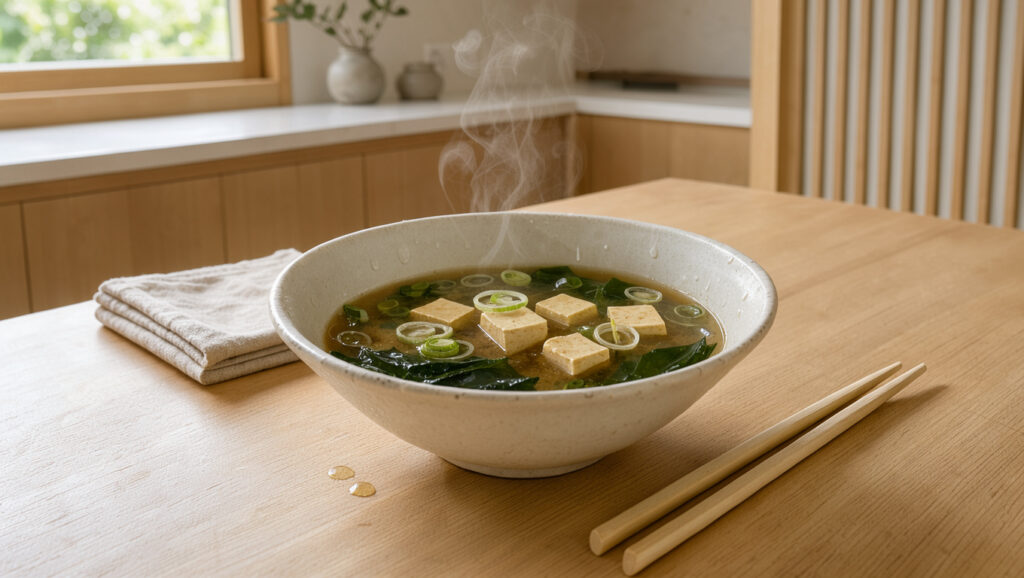
Is Miso Soup Good for You? Nutrition, Risks and Sodium Facts
Miso soup gets praised for nearly everything, yet one tablespoon of the paste carries about 630 mg of sodium, according to Hikari Miso (quoting Consumer Reports). This article separates the nutrition facts from the health claims the sources don’t back up.
Calories per 1 tablespoon miso paste: 33.7 kcal · Protein per 1 tablespoon miso paste: 2.2 g · Carbohydrates per 1 tablespoon miso paste: 4.3 g · Fat per 1 tablespoon miso paste: 1 g
Quick snapshot
- One tablespoon of miso contains about 34 calories, 1 g fat and 4 g carbohydrates (WebMD (consumer health reference))
- A 2020 review found miso soup frequency was not linked to blood pressure or hypertension (Springer (peer-reviewed journal))
- The heat threshold for live cultures is unclear: about 46 C (115 F) per NutriScan (nutrition database), versus about 70 C (158 F) per Just One Cookbook (culinary publisher)
- Heartburn relief has no confirmed source in the research reviewed. (NutriScan (nutrition database))
- Laxative and timing claims lack sourced evidence. (NutriScan (nutrition database))
- A 2021 study linked daily miso to better glycemic control in diabetic women (University of Arizona Center for Integrative Medicine (academic research summary))
- A 2020 cross-sectional study of 527 Japanese adults aged 50 to 81 found no link between miso soup frequency and blood pressure (biomanutrient.app (nutrition summary site))
- Stir miso in off heat rather than boiling it, to protect live cultures (Just One Cookbook (culinary publisher))
- Compare sodium on labels before choosing instant packets.
Six numbers, one pattern: a tablespoon is light on calories and fat, so its sodium is the figure that decides how much of it a bowl can carry.
| Nutrient | Amount |
|---|---|
| Serving size | 1 tablespoon miso paste |
| Calories | 33.7 kcal |
| Fat | 1 g |
| Carbohydrates | 4.3 g |
| Protein | 2.2 g |
| Sodium | 630-634 mg per 17 g |
What happens to your body when you eat miso soup regularly?
“Miso soup is great because it’s fermented and good for your gut.”
Katsuyoshi, chef quoted in Vogue (fashion and lifestyle magazine)
Expert praise like this describes the food, not a measured outcome, so the sections below sort what the studies actually found.
Which nutrients does miso naturally contain?
- Protein: BBC Good Food (UK nutrition publisher) puts one tablespoon (15 g) at about 30 kcal and 2.0 g protein.
- Zinc, manganese and vitamin K appear in some food-site summaries, but the sources reviewed give no amounts, so treat them as unverified.
Per tablespoon, the nutrient numbers are small, and the salt is the larger effect.
What are the health risks of miso?
- Sodium: about 630 mg per tablespoon (Hikari Miso (quoting Consumer Reports)), which is over a quarter of the 2,300 mg daily limit set by the American Heart Association (InnerBuddies (gut-health blog)).
- Men who ate the most miso soup had about 17% higher stomach cancer risk across 13 studies of 517,106 people, according to biomanutrient.app (nutrition summary site), which is a secondary summary.
- Soy is goitrogenic and can interfere with iodine absorption, and people on warfarin or with thyroid conditions may need to limit intake (BBC Good Food (UK nutrition publisher)).
- Soy allergens remain in miso, and fermentation reduces but does not eliminate them (Biocodex Microbiota Institute (research institute)).
“Miso … has a high sodium content and is relatively high in sodium, with about 630 milligrams per tablespoon.”
Consumer Reports News, quoted by Hikari Miso
Almost all of the long-term evidence comes from Japanese populations, and it is observational. Observational studies can show an association without proving a cause.
A daily bowl adds little nutrition, so its health effect depends on how much salt the rest of your diet already carries.
Does miso soup help with heartburn?
The closest signal comes from a Japanese study by Mano (2018), summarised by the University of Arizona Center for Integrative Medicine (academic research summary). Daily intake was associated with fewer epigastric, or GERD-type, symptoms.
That is a symptom association, not proof of relief, and the heartburn claim itself remains unverified.
Does miso soup act as a laxative?
- No source in the research reviewed supports a laxative effect, so the claim stays unverified.
- The digestive data come from observational Japanese work, so they cannot establish a laxative effect.
The catch: anyone managing reflux should check the salt load first, and a single tablespoon carries about 630 mg, so the symptom signal and the sodium figure pull in different directions.
How often should you drink miso soup?
No source in this research sets a daily limit for miso soup, so moderation is the framing the evidence supports.
“Although miso soup has many health benefits and is a low-calorie, low-fat dish, there are a few potential risks.”
WebMD editorial, consumer health reference
What time of day is best to eat miso soup?
- No sourced evidence supports a morning benefit or a bedtime benefit.
- Sodium is the variable the sources measure, so the salt in the bowl matters more than the hour.
Are there benefits of miso soup before bed?
- Bedtime benefit claims are unverified in the research reviewed.
- None of the cited studies tests bedtime intake directly.
The Health.com (health magazine) summary reports a traditionally prepared cup at about 65 calories and 895 mg sodium, or 39% of the daily value. Two cups would bring 1,790 mg, about 78% of the 2,300 mg daily limit.
Restaurant miso ramen can exceed 1,500 mg of sodium per bowl, according to CalmEats (food blog).
Two cups a day would use most of the daily sodium limit before any other meal is counted.
A small trial found that two daily bowls for 8 weeks, with about 3.8 g of salt, did not raise daytime blood pressure compared with a low-salt soy food, though night-time pressure was lower (biomanutrient.app (nutrition summary site)). The trial was small, and no effect size was reported.
The trade-off: frequency is where sodium adds up, so a moderate habit matters more than any timing rule.
A reader who drinks two cups a day takes in about 1,790 mg of sodium from miso alone, which uses most of the 2,300 mg limit before any other meal.
Which miso soup is the healthiest?
Instant and homemade bowls differ most in what gets added around the paste.
Is instant miso soup healthy?
- Instant packets are generally pasteurised, so most live cultures are lost, and they often contain added sodium, preservatives, MSG and wheat gluten (WebMD (consumer health reference)).
- A Japanese nutrition blog (note.com (Japanese nutrition blog)) estimates a homemade bowl at about 1.2-1.5 g of salt versus 1.5-2.0 g for instant. That figure is low confidence and has not been checked against product labels.
What is the shelf life of miso?
- The sources reviewed give no shelf-life figure for miso.
- Take the date and storage guidance from the manufacturer’s label, since storage changes the answer.
Three differences, one pattern: homemade bowls keep the paste and the salt under your control, while instant packets trade live cultures for convenience.
| Feature | Homemade miso soup | Instant packet |
|---|---|---|
| Sodium | Set by how much paste you add | Often higher, with added salt |
| Live cultures | Kept when unpasteurised paste is stirred in off heat | Largely lost, because packets are generally pasteurised |
| Additives | None beyond the paste and broth you choose | Often MSG, preservatives and wheat gluten |
Upsides
- No blood-pressure penalty appeared in a 2020 review of observational studies (Springer, peer-reviewed journal).
- Live cultures survive when unpasteurised paste is stirred in off heat (Just One Cookbook, culinary publisher).
Downsides
- Sodium is the main cost, covered in the risks section above.
- Thyroid and blood-thinning cautions apply, also covered above.
The implication: a homemade bowl with unpasteurised paste is the better bet on live cultures and additives, while instant packets trade those for convenience and extra salt.
Anyone who picks an instant packet over a homemade bowl trades live cultures for convenience and usually takes on more sodium, so the label decides the outcome.
Do Japanese drink miso soup every day?
Where does miso originate from?
- Miso is a traditional Japanese fermented soybean paste, fermented with Aspergillus oryzae (koji), Zygosaccharomyces rouxii and Tetragenococcus halophilus (Biocodex Microbiota Institute, research institute).
- The sources reviewed do not give a date for when miso was first made.
Why do Japanese always eat miso soup?
The Japanese cohort data show a pattern, but the effect is not fully explained by nutrients, so frequent drinking in Japan does not by itself show a health effect.
- Traditional practice is to drink miso soup with meals, often as part of ichiju sansai meals (Just One Cookbook, culinary publisher).
- The Japan Collaborative Cohort Study observed lower heart-disease mortality associated with regular miso soup consumption (InnerBuddies), though the sources do not explain the effect through nutrients alone and the primary study was not retrieved.
Surveys cited by InnerBuddies put typical intake at one to two bowls daily, but that figure is low confidence and was not checked against a national survey.
The implication: cultural habit shows what people eat, not what it does to them.
Related reading: is miso soup good for you
Frequently asked questions
Why do I feel so good after eating miso soup?
None of the sources reviewed measures how people feel after a bowl, so no sourced explanation exists. The nutrient numbers per tablespoon are small enough that they do not account for the feeling on their own.
Does miso soup have benefits for men?
The sources reviewed show no sourced benefit specific to men. The insulin resistance finding and the mortality finding both apply to women only, and the stomach cancer finding for men is observational and comes from a secondary summary.
Is miso paste a good source of protein?
It contributes some protein, at 2.2 g per tablespoon, but the amount is modest. A bowl adds little protein compared with the sodium it carries.
Does miso soup contain probiotics?
Miso is fermented, and live cultures survive only when unpasteurised paste is stirred in off heat. Instant packets are generally pasteurised, so most live cultures are lost, and sources disagree on the heat threshold, at 46 C or 70 C.
Does miso soup contain vitamin K?
Some food-site summaries say so, but the sources reviewed give no amounts, so the claim stays unverified.
More related posts
 Full Suspension Mountain Bike Under $1000 NZ: Best Picks
 The Way We Were: Famous Line, Breakup, and Song Explained
 What Is a Checksum? Definition and How to Run One
 MasterChef Back to Win – 2024 Judges, Contestants, Results
 Eltham Taranaki House Fire: What We Know
 1 NZD to Thai Baht – Live Rate, Forecast & Conversions
 Run Away (2026) – Plot, Cast, Reviews and Where to Stream
 Is Roblox Shutting Down? No, Here’s the Truth on Rumors