Business Class Air NZ: What You Get & Is It Worth
You’ve seen the ads for Air New Zealand’s Business Premier — lie-flat beds, Koru lounges, and multi-course meals. But does the reality match the marketing, and is it actually worth the upgrade from Premium Economy?
Seat type: Lie-flat bed with memory foam mattress ·
Bed length: 6’6″ (198 cm) ·
Checked baggage: 2 x 23 kg (50 lb) ·
Lounge access: Complimentary at airports worldwide ·
Priority services: Check-in, boarding, security
Quick snapshot
- Lie-flat bed with memory foam (Air New Zealand official specs)
- Priority check-in & boarding included (Air New Zealand official comparison)
- Koru lounge access worldwide (Going guide)
- Fine dining and premium wines (Air New Zealand official)
- Excellent seat comfort for sleeping (Pat’s Travel Reviews)
- Large in-flight entertainment screen (Pat’s Travel Reviews)
- Friendly crew and Kiwi service style (Allen on Travel)
- Consistent product across 787 and 777 fleet (Air New Zealand official)
- High cost compared to Premium Economy (Going guide)
- Some 777 seats lack direct aisle access (SeatGuru)
- Limited privacy in center pairs (Going guide)
- Long-haul travelers wanting quality sleep
- Business travelers needing productivity
- Passengers valuing lounge access
- Couples traveling together
Here’s a quick look at the standard specs for Business Premier:
| Feature | Details |
|---|---|
| Seat Type | Lie-flat bed with memory foam mattress (Air New Zealand official) |
| Bed Length | 6’6″ (198 cm) |
| Meal Service | Multi-course, chef-designed menu |
| Lounge Access | Koru lounge and partner lounges (Going guide) |
| Baggage Allowance | 2 checked bags x 23 kg (Air New Zealand official) |
| Check-in Priority | Dedicated counter and priority boarding |
What does air nz business class get you?
Priority check-in and boarding
Business Premier passengers use a dedicated check-in counter at most international airports. Boarding is also priority, meaning you board ahead of Premium Economy and Economy. This alone can save 10–20 minutes at the gate.
Complimentary lounge access
Air New Zealand gives Business Premier passengers access to its Koru lounges and partner Star Alliance lounges worldwide. For comparison, Premium Economy passengers do not receive lounge access unless they hold status with Air New Zealand or a Star Alliance partner, as noted by travel guide Going (travel booking guide).
Koru lounge access alone can cost NZ$99–$149 per visit for non-Business passengers. For frequent long-haul flyers, Business Premier effectively covers that cost in the ticket — but only if you actually use the lounge.
Baggage privileges
Business Premier includes 3 checked bags at 23 kg each, plus 2 carry-on pieces. Premium Economy gets 2 checked bags and 2 carry-ons. Economy gets just 1 checked bag at 23 kg and 1 carry-on, per Air New Zealand’s official comparison table.
Fine cuisine and wine
Meals in Business Premier are multi-course menus designed by chefs, served with New Zealand wines. While Premium Economy has upgraded meals — better than Economy — the quality, presentation, and wine selection in Business are a clear step up.
Seat and bed features
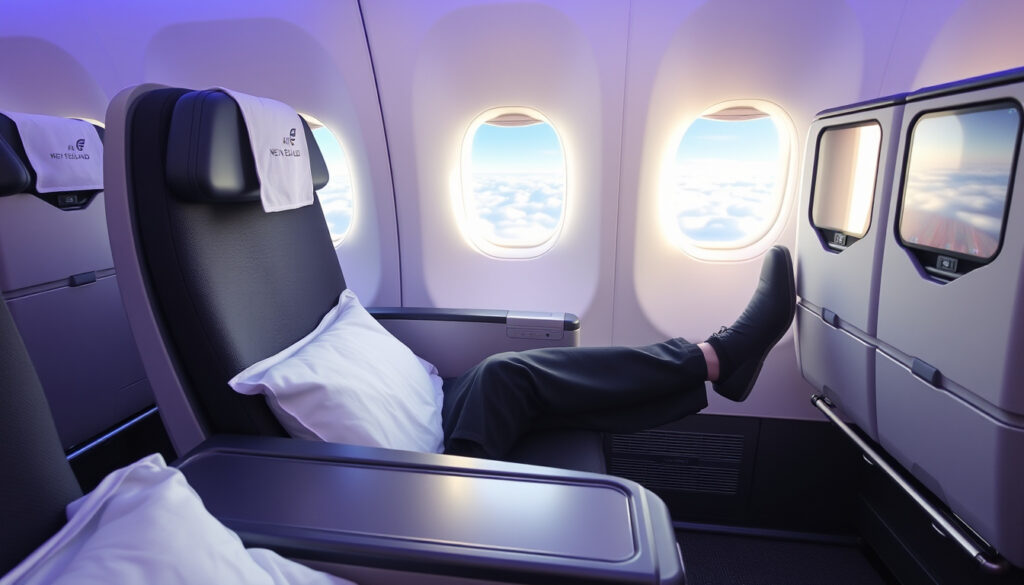
The leather seat converts to a fully lie-flat bed. Each seat comes with a memory foam mattress pad, two pillows, and a duvet. On the Boeing 787-9, the configuration is 1-2-1 — every seat has direct aisle access. On the 777-300ER, the layout varies and some center seats lack direct access.
Business Premier delivers the full package: lounge, priority, generous bags, and a real bed. The value stack works best for travelers who consistently use all five perks.
Is business class worth it on air in New Zealand?
Cost vs value
A Business Premier ticket on a route like Auckland to Los Angeles can cost NZ$6,000–$8,000 round-trip, while Premium Economy runs around NZ$3,000–$4,500 and Economy NZ$1,500–$2,500. The premium over Premium Economy is roughly 60–80%.
For a 12–14 hour flight, the lie-flat bed means you can arrive rested and skip a night of jet lag recovery. That’s worth real money if you’re heading straight into a work day.
Who benefits most from business class?
- Solo business travelers who need sleep before a meeting
- Couples who can sit together in the center pair
- Tall passengers who struggle in a standard 32-inch pitch seat
- Anyone flying 10+ hours from New Zealand to the US, UK, or Asia
Comparison with premium economy pricing
Premium Economy on the same Auckland–LA route might cost NZ$3,500. You get extra legroom (41–42 inches pitch), upgraded meals, 2 checked bags, and priority baggage delivery — but no flat bed and no lounge access.
Passenger reviews and ratings
Reviews on blogs like Pat’s Travel Reviews (passenger review site) and Allen on Travel (independent travel blog) both cite comfort, service, and the lie-flat bed as key differentiators. One reviewer said both cabins were “excellent, comfortable, and spacious” but noted the lie-flat feature is the core value.
The pattern: For flights under 8 hours, many budget-conscious travelers find Premium Economy sufficient. Above 10 hours, the bed in Business Premier becomes the deciding factor.
What’s the difference between Premium Economy and business class?
Seat differences
Business Premier seats convert to a fully lie-flat bed measuring 6’6″ (198 cm). Premium Economy seats recline — with a pitch of 41–42 inches and width of 19 inches — but do not come close to lying flat, as Going (travel booking guide) confirms.
Service and amenities
Business includes priority check-in, priority boarding, dedicated cabin crew ratio, and lounge access. Premium Economy gets priority baggage delivery but no lounge access unless you have elite status.
Food and beverage
Business serves multi-course meals with wine pairings. Premium Economy meals are upgraded from Economy but not to the same standard — one course fewer and no sommelier-level wine service.
Lounge access
This is the biggest gap. Business passengers get complimentary access to Koru lounges and Star Alliance partner lounges worldwide. Premium Economy passengers do not.
Price difference
On a typical Auckland–Los Angeles route, Business Premier is roughly 60–80% more expensive than Premium Economy. On shorter routes like Auckland–Sydney, the gap is smaller since the cabin is not available on those segments (Airbus narrowbodies lack a Business Premier cabin).
The trade-off: Premium Economy gives you 80% of the seat space for 50% of the price — but loses the lie-flat bed, the lounge, and the kitchen.
Here’s a side-by-side comparison of the key differences:
| Feature | Business Premier | Premium Economy |
|---|---|---|
| Seat type | Lie-flat bed (6’6″) | Reclining seat (41-42″ pitch) |
| Lounge access | Complimentary Koru & Star Alliance | Not included |
| Checked baggage | 3 x 23 kg | 2 x 23 kg |
| Meal service | Multi-course with wine pairings | Upgraded but fewer courses |
| Priority services | Check-in, boarding, security | Priority baggage delivery only |
Does Air New Zealand business class have flat beds?
Seat transformation
Yes — every long-haul Business Premier seat converts to a lie-flat bed. The official product page from Air New Zealand (national carrier) confirms this as the standard offering across the 787-9 and 777-300ER fleets.
Bed dimensions and comfort
Bed length is 6’6″ (198 cm) with a memory foam mattress pad, two pillows, and a duvet. The seat pitch is effectively infinite once flat — you lie horizontally, not at an angle.
Mattress and bedding
The memory foam mattress pad is a differentiator. Most airlines offer a thin pad; Air New Zealand’s is noticeably thicker and plush. The duvet is full-size and the pillows are plush.
Comparison with other airlines’ flat beds
Singapore Airlines, Cathay Pacific, and Qantas all offer lie-flat beds in business class. Air New Zealand’s product is competitive but not class-leading — it lacks the suite door that some competitors now offer. However, the Kiwi service style and bedding quality earn consistent praise.
If you’re choosing between airlines solely for sleep quality, Air New Zealand’s lie-flat bed is among the better options in the Pacific region — but passengers who value privacy above all will prefer Singapore Airlines’ enclosed suites.
Which airline has the nicest business class?
Air New Zealand vs Singapore Airlines
Singapore Airlines offers enclosed suites with doors and better dining. Air New Zealand’s strength is in the soft product — the bedding and crew warmth. Skytrax consistently ranks both in the top 10 globally.
vs Cathay Pacific
Cathay Pacific’s business class has a similar 1-2-1 layout but is known for quieter cabins and higher seat-service consistency. Air New Zealand wins on lounge quality (Koru lounges are larger and better-stocked than Cathay’s flagship lounges in Hong Kong, which suffered during the pandemic).
vs Qantas
Qantas offers a similar lie-flat product on its A380s and 787s. The key difference: Qantas Business passengers get access to the Qantas First Lounge in Sydney and Melbourne — considered among the best in the world. Air New Zealand counters with Koru lounge availability at more airports across New Zealand.
Key differentiators for Air NZ
- Koru lounge — better domestic and short-haul coverage
- Kiwi service style — friendlier, less formal
- Award-winning wine selection focused on New Zealand producers
- Consistent hard product across 787 and 777 fleet
Air New Zealand wins on ground experience (lounges, priority) and crew warmth. But its hard product — while excellent — doesn’t match the privacy and seat technology of Singapore Airlines or Cathay Pacific. Your choice depends on whether you value service or solitude.
Which seat to avoid in flight?
Seat map considerations
On the 777-300ER, rows 5–7 are near the forward galley and lavatories, which means more foot traffic and noise during meal service. On the 787-9, seats in the center section of row 1 and row 2 can have reduced privacy because they face the galley curtain.
Rows to avoid (near galley, lavatories)
SeatGuru maps for the 777-300ER show that rows near the aft lavatory (row 8–10 in some configurations) also suffer from queuing passengers and door sounds.
Best seats for privacy
On the 787-9, window seats (A and K) in odd-numbered rows are farthest from the aisle and offer the most privacy. Center seats (D and G) in the same rows are paired, so couples traveling together may prefer these.
Tips for choosing on 777-300ER and 787-9
- Choose window seats for solitude (A or K on 787, A or K on 777)
- Avoid rows directly adjacent to galleys (rows 5–7 on 777, rows 1–2 center on 787)
- Select the rear Business cabin on 777-300ER (rows 8–16) for quieter experience
- Check SeatGuru before booking for the specific aircraft registration
The implication: A few minutes of research before selecting your seat can make the difference between a restful flight and a noisy one. This matters most for business travelers who need to sleep on a 7-hour overnight eastbound flight.
Confirmed facts
- Air New Zealand Business Premier seats convert to lie-flat beds (Air New Zealand official)
- Complimentary lounge access is included for Business passengers (Going guide)
- Baggage allowance is 3 checked bags x 23 kg in Business, 2 x 23 kg in Premium Economy (Air New Zealand official comparison)
- Free Wi-Fi is available on most aircraft (Air New Zealand official)
What’s unclear
- Priority check-in, boarding, and baggage services are standard — but exact availability may vary by airport
- Exact menu and wine selection may vary by route and season
- Prices fluctuate based on demand, booking window, and time of year
- Some aircraft have slightly different seat configurations — always check the specific aircraft registration
Air New Zealand have a new Business Premier upgrade, so we had to get onboard to review it.
— The Sauce Mag review
The cabin itself is very spacious and light and there are two Business Premier sections on the 777-300ER.
— Travel Nation review
For Business Premier passengers, the decision to upgrade comes down to one question: How much is a full night’s sleep worth to you on a 14-hour flight? The bed is real, the lounge access is genuine, and the service is consistently excellent. For travelers flying from New Zealand to the United States, the United Kingdom, or Asia, the value proposition is clear: arrive rested, or spend a day recovering. For those on shorter routes — Auckland to Sydney or the Pacific Islands — Premium Economy is usually enough. For the 10-hour-plus journey, Business Premier is the smarter choice.
For a detailed look at the full experience, this Air New Zealand business class review covers everything from pricing to inclusions.
Frequently asked questions
Can I sleep in Air New Zealand business class?
Yes. Business Premier seats convert to fully lie-flat beds with a memory foam mattress, two pillows, and a duvet. Bed length is 6’6″ (198 cm).
Is Wi-Fi available in business class?
Free inflight Wi-Fi is available on most Air New Zealand aircraft, including Business Premier cabins, per the official site.
Can I earn Air Points on a business class ticket?
Yes. Business Premier tickets earn Air New Zealand Air Points based on fare class and distance. Higher fare buckets earn more points.
What aircraft types have Business Premier seats?
Boeing 787-9 and 777-300ER aircraft are equipped with Business Premier cabins. Airbus narrowbodies used on short-haul routes do not have a Business Premier cabin.
How do I upgrade to business class?
You can use Air Points or cash upgrades at check-in if seats are available. Some credit cards with Air New Zealand partnerships also offer upgrade vouchers.
What is the cancellation policy for business class tickets?
Business Premier tickets generally offer more flexible cancellation and change policies than Economy, but specific terms depend on the fare class purchased. Check your ticket conditions carefully.
Are there power outlets in business class?
Yes. Business Premier seats include universal AC power and USB-A charging ports. Premium Economy and Economy also offer charging, but Business has the most accessible configuration.
Related reading: Bali Holiday Packages NZ 2026 · What to Do in Auckland for a Day
More related posts
 Christchurch Airport Car Rental: Compare Companies & Save Money
 Cast of Beetlejuice 2: Returning & New Actors, Missing Stars
 MSR Hubba Hubba 2 Review: Weight, Dimensions, and What to Know
 Clarke Gayford Sad News: Death Rumours Debunked & Facts
 Is Roblox Shutting Down? The Truth Behind the Rumors
 Best Power Company for Solar Buy Back NZ: Compare Rates
 Lilo & Stitch Movie 2025: Cast, Release & Facts